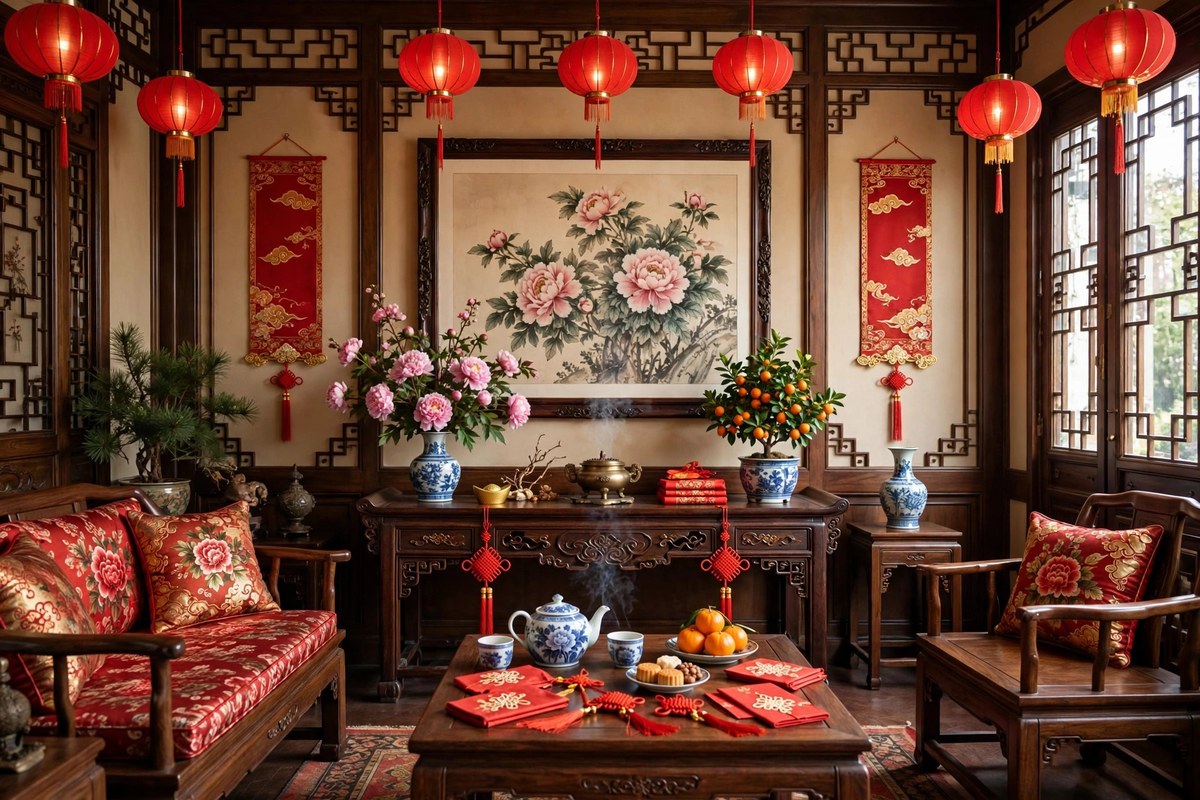
A week before Chinese New Year, something happens in Chinese neighborhoods that you can spot from a block away. Red starts appearing — first on one gate, then another: paper diamonds pasted to doors, lanterns going up under the eaves, long banners of calligraphy flanking every entrance. Inside, the walls get dressed too — peonies, carp, calligraphy. The whole house seems to be talking at once.
And it is talking. That is the part most decorating guides get wrong. Chinese New Year decor is not really decor — it is speech. Every image hung and every character pasted is a wish said out loud: for money that arrives on time, for grandparents who stay healthy another year, for luck that finally turns your way. Once you learn the language, shopping for chinese new year decorations stops being a scavenger hunt and becomes writing a letter to the coming year.
This guide is that language, translated for your walls. We will go from the door inward — door gods to spring couplets — through nianhua folk prints and auspicious subjects for every room, to the New Year tea table. The short version of chinese new year decorations meaning: red for protection, pairs for harmony, and everything bright, crowded, and shamelessly optimistic.
The Door Comes First: Fu, Couplets & Door Gods
In a Chinese home, New Year decorating starts at the threshold and works inward, because the door is where fortune enters — or gets turned away. The oldest fixture is the pair of door gods (menshen), fierce generals pasted on the two leaves of the gate. Their job is simple: stand there looking terrifying so that demons, bad luck, and ill-wishers think twice.
Above them goes the season's most famous character: fu — fortune, blessing, good luck in one. And it goes up upside-down, deliberately. In Mandarin, "upside-down" (dao) sounds exactly like "arrived," so an inverted fu is a pun you can hang on a wall: fortune has arrived. Guests notice it, grin, and say it out loud.
Flanking the door, in tall strips of red paper with black or gold characters, hang the spring couplets (chunlian): two lines of poetry, matched line for line, wishing the household prosperity, health, and harmony. Bold brushwork reads as a strong year ahead — families with a scholar's hand write their own; everyone else buys from the street stalls that appear every January. Either way, the couplets go up fresh each year. Last year's come down. A new year gets new words.
For ready-made wall art in the same spirit, browse auspicious scroll paintings for the New Year — peonies, carp, and pine-and-crane compositions in the classic hanging-scroll format that suits the season's bold red palette.

Nianhua: The People's Festival Art
Before there were posters, there was nianhua — New Year woodblock prints, China's first mass art. The great workshops of Yangliuqing near Tianjin and Taohuawu in Suzhou turned out millions: chubby babies clutching fat carp, magpies on plum branches, the God of Wealth with his treasure train, opera heroes mid-pose — printed in loud color on cheap paper, pasted up fresh each year and replaced when the year turned.
A nianhua was never meant to be precious — it was a blessing with a one-year shelf life. The style is joyful and direct: big faces, saturated reds and greens, compositions crowded with good things. No minimalist beige survives contact with real lunar new year wall art — and that is the charm. Where literati painting whispers, nianhua shouts.
You don't need antiques to catch the spirit. Look for the same subjects in today's formats — a scroll of children with lotus (the lotus puns with "continuous"), magpies on plum announcing joy. The folk vocabulary translates cleanly onto silk; what matters is the brightness and the blessing, not the medium.

Auspicious Subjects, Room by Room
Once the door is dressed, the interior gets its own program — different rooms, different wishes. The living room is the public face of the household, so it gets the boldest symbols of prosperity: peonies, the "king of flowers," standing for wealth and high rank, ideally in full, blowsy bloom. A peony scroll over the sofa tells every guest exactly what kind of year you intend to have.
The elders' corner belongs to the pine and crane. Pines stay green through winter; cranes were said to live a thousand years. Together they are the standard wish for longevity, and hanging them where the oldest generation sits is decor and filial respect made visible. A study does well with plum blossom — the scholar's emblem of integrity — or a quiet landscape suggesting the leisure the new year should bring.
And everywhere, carp. The fish (yu) puns with "surplus," so a pair of koi is the wish "may you have surplus year after year" swimming on your wall. Nine carp is even better — nine (jiu) puns with "long-lasting." For a business associate's office, carp and horses (success arriving at speed) are the safest picks in the symbolic catalog.
One rule crosses every room: hang in pairs when you can. Symmetry reads as harmony, and harmony is the quiet foundation under all the louder wishes for wealth and luck. A single dramatic piece makes a statement; a matched pair makes a blessing.

Timing, Gifting & House Rules
Decorating has a calendar. The traditional window runs from Little New Year — about a week before the festival, when the Kitchen God reports to heaven — through New Year's Eve, when the last couplet goes up and the house is declared ready. Decorating early is fine; decorating late reads as a household that couldn't get its year together. Never leave last year's couplets up past the changeover — faded, curling paper advertises a stale year.
Then come the house rules, and they are charmingly absolute. Never sweep on New Year's Day — you would sweep the freshly arrived luck straight out the door. Brooms rest; dust waits. Sharp objects stay sheathed, crying is discouraged, and the first words spoken in the morning should be auspicious ones. Whether or not you believe it, guests notice — and the household relaxes into the performance.
For gifts, think paired, red, and round: mandarin ducks for newlyweds, pine-and-crane art for grandparents, koi for business friends. And consider commemorative coins — the God of Wealth and zodiac issues are traditional New Year gifts precisely because they are wealth you can hold. Browse Chinese commemorative coins for auspicious pieces that work as gifts and as keepsakes of the year.
Above all, remember the aesthetic rule that governs everything above: the best New Year art is bright, crowded, and unabashedly optimistic. Restraint is for March — hang the peonies, paste the fu upside-down, and let the house say what you hope.
Start the Year Right
Dress your home for the New Year, and the year dresses you in return — in health, wealth, and happiness. Start with the door, work inward, mind the calendar, keep the tea hot. Find auspicious New Year art — peonies for wealth, carp for surplus, pine and crane for the grandparents — and give the coming year something worth living up to.