
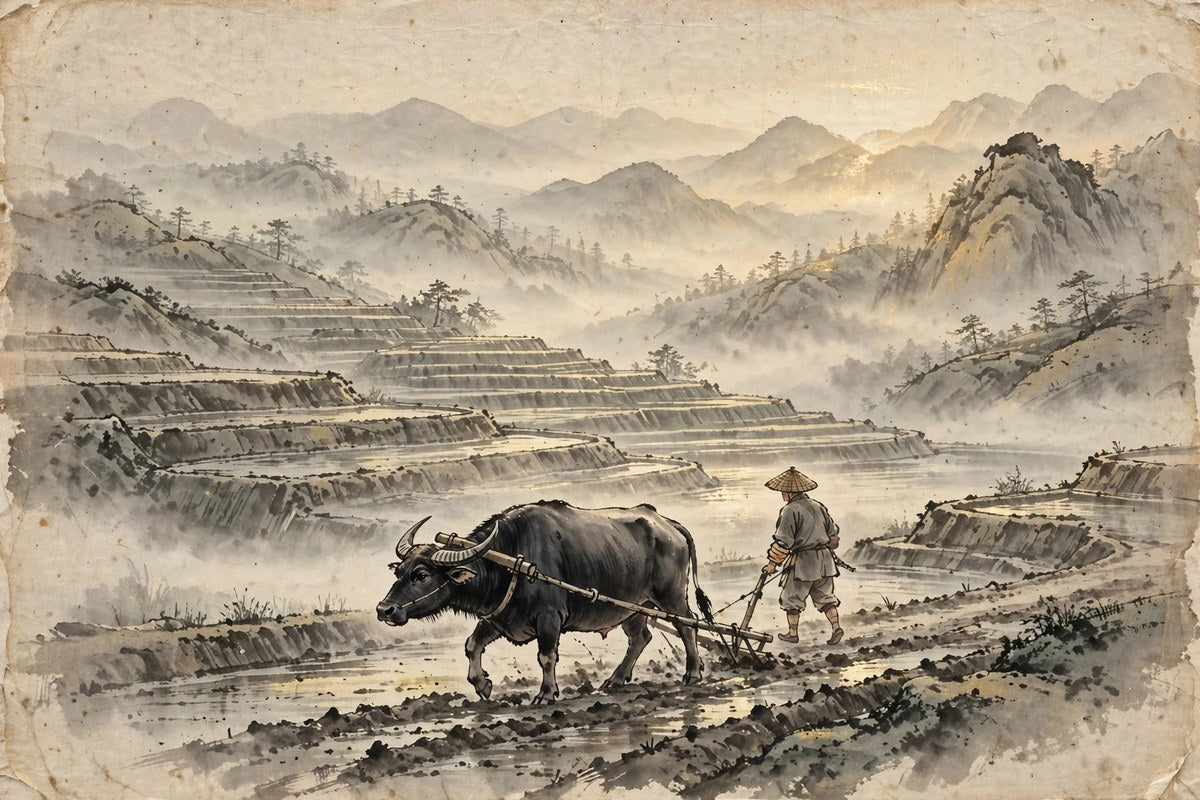
The Ox in Chinese Art: Strength, Patience, and the Long Furrow
"Fierce-browed, I coolly defy a thousand pointing fingers. Head bowed, like a willing ox I serve the children." The poet Lu Xun (1881–1936) wrote those lines about himself, and he chose the ox deliberately. He could have compared himself to a tiger or a dragon; he chose the animal that lowers its head and pulls. That is the ox in Chinese culture in a single image: strength that does not show off, patience that does not quit.
The ox (牛, niú) is the second animal of the zodiac (生肖, shēngxiào), the only one whose reputation was earned in the fields rather than in a story. Nobody had to invent a myth to explain why the ox matters: anyone who had watched one pull a plow through wet spring soil already knew.
The Animal That Fed China
Plowing with oxen became common in China during the Warring States period (475–221 BCE), and from then on the ox was the backbone of food itself. The Han writer Ying Shao, in his Record of Popular Customs of about the 2nd century CE, described the ox as the farmer's foundation. Without the ox there was no plowed field, and without the field there was no harvest.
That working history is why the ox means something different from the other zodiac animals. The dragon means power, the tiger means protection. The ox means diligence, dependability, and the willingness to do the same necessary job every day without applause. In modern Mandarin the praise still survives in the phrase lao huangniu, the "old yellow ox," used for a person who works steadily and complains little — one of the highest compliments in the language, paid in the name of a farm animal.
Painters understood this. The classic pastoral image in Chinese art is a boy riding an ox home at dusk, playing a flute, with the animal walking at its own unhurried pace. The boy is carefree because the ox is reliable. The picture is a wish as much as a scene: may your work be steady, may your evenings be easy. An ox painting carries that wish into the room.
Beating the Clay Ox to Wake the Spring
Every year at the Start of Spring, officials in imperial China built a clay ox — the 土牛 (tǔniú) — and beat it with switches to coax the season along and mark the beginning of plowing. The ceremony, called "whipping the spring ox," was performed by the emperor in the capital and by officials in the provinces. It was a farming calendar made visible: the ox wakes, the fields open, the work begins.
The rite explains why the ox is a spring animal as much as a farm animal. An ox painting given at Lunar New Year is more than a birthday gift. It is a wish for a productive year, the visual equivalent of beating the clay ox: may the season start well, may the work go smoothly, may the harvest follow. That is why ox art surges every twelve years when the Year of the Ox comes around, and why it also makes sense as a gift for a new job, a new business, or a new home — any beginning that depends on steady work rather than luck.
The second detail is the ox's role in the Great Race. The ox did all the swimming, carried the rat across the river on its back, and still came second because the rat jumped off its head at the bank. The ox does not complain. It accepts the result and walks on — and that is why the ox is the zodiac's secret friend to the rat, the steady partner the clever animal needs.
Ten Pictures of a Boy and His Ox
The ox's most serious appearance in Chinese art is not a farm scene at all. It is the Ten Ox-Herding Pictures, a series created by the 12th-century Chan (Zen) master Kuoan Shiyuan. Ten images follow a boy who searches for a lost ox, finds it, catches it, tames it, rides it home, forgets it, and finally walks back into the marketplace with open, helping hands.
The ox here is not livestock. It is the seeker's own true nature — the mind, wild at first, then gradually gentled until the boy can ride it home. The sequence is the most famous visual teaching in Zen Buddhism, copied across China, Korea, and Japan for eight hundred years. The eighth picture stops people: an empty circle, because by then both the ox and the boy have been forgotten. The last two pictures bring them back to ordinary life — the whole lesson: enlightenment is not an escape from work, it is a return to it, done differently.
Ox art has two registers for different rooms. The pastoral ox — the boy riding home at dusk, the ox in the field — is warm and gentle, suited to a living room or a study. The Zen ox — the herding pictures — is contemplative and spare, for a study, a meditation corner, or an office where someone wants a reminder to slow down. Buying the wrong register is the most common mistake with ox art: a Zen ox-herding scroll in a busy living room reads as homework, and a cheerful folk ox in a meditation space reads as noise.
Your Ox Years — and the Two Elements That Shape Them
Like every zodiac animal, the ox has a fixed element (五行, wǔxíng) and each birth year adds a rotating one. The ox's fixed element is Earth: grounded, patient, practical, the element of soil itself.
- 1925, 1985 — Wood Ox: steady growth, honest, slower to anger.
- 1937, 1997 — Fire Ox: energetic and determined, but with a shorter fuse.
- 1949, 2009 — Earth Ox: the fixed element doubled: practical, reliable.
- 1961, 2021 — Metal Ox: disciplined, strong-willed, the most stubborn.
- 1973 — Water Ox: quieter, more adaptable, the most flexible.
A person born in 1985 and a person born in 1997 are both oxen, but not the same kind of ox. A gift that names the year element — "for a Metal Ox" — shows the giver did more than pick one. The rest of the profile is consistent: lucky numbers 1 and 9, lucky colors red, blue, and purple, and a personality described as diligent, dependable, strong, determined, and honest.
Compatibility follows the same logic as the animal itself. The ox gets along best with the Snake, the Rooster, and the Rat — the Snake and Rooster form the ox's trine (三合, sānhé), and the Rat is the ox's secret friend (六合, liùhé) from the river crossing. The pairing to avoid (相沖, xiāngchōng) is the Sheep: the ox wants routine and steady progress, the Sheep wants comfort and change, and neither is wrong, which is exactly why they frustrate each other.
One Date That Changes Everything
Before you buy a gift for a January or February birthday, check the Spring Festival date for that year. The zodiac year does not begin on January 1. It begins on Lunar New Year, which falls between January 21 and February 20, and anyone born before that year's Spring Festival belongs to the previous year's animal. The 2021 Spring Festival fell on February 12, so a baby born on February 1, 2021 is not an Ox at all — that child is a Rat. The same trap catches the famous example in the other direction: someone born in January 1990, before that year's Spring Festival, is a Snake, not a Horse. A wrong animal on a birthday gift is the most common mistake in zodiac shopping. When in doubt, check the date first.
Where to Hang an Ox
Put the ox where work happens. The study and the home office are the natural spots: the animal's message is diligence. A living room works too: the boy riding home at dusk settles a room. The entrance hall is a good third choice: the ox at the door says this household keeps its promises.
Keep ox art out of bedrooms: the ox is a working animal, and its energy is the opposite of rest. The same applies to a child's room, where a large ox can feel heavy and watchful. Do not hang an ox facing a Sheep painting in the same sightline: the two animals clash.
Choosing Your Ox
Start with the head. In a good ox painting it is lowered, not raised: the bowed head is the whole symbol, the willingness to pull. An ox with its head thrown back is a fighting ox, carrying a different message — defiance rather than diligence. For a home or an office, the lowered head is the right choice.
Composition is the second check. A single ox in a field is a personal talisman, good for one person's desk or birthday. A boy riding an ox home is a household wish — better for a wedding, a new home, or a retirement. A Zen ox-herding scene is a different purchase: buy it for someone who meditates or studies, and hang it where it will be looked at slowly.
If you are buying for an ox-year birthday, the ox zodiac collection gathers the animal's coins and gifts in one place, and a Chinese scroll painting of a pastoral ox makes the gift feel chosen rather than generic. A commemorative coin from an ox year is the smaller option, for a desk drawer or a display shelf. Write the birth year on the card. The ox rewards people who get the details right.