Chrysanthemum in Chinese Culture: The Autumn Flower of Longevity
In China, flowers are never just decoration. Each one is a character statement, a shorthand for the kind of person you are or hope to become. Plum blossom stands for resilience, the orchid for refinement, bamboo for unbending integrity — and the chrysanthemum, which blooms when everything else in the garden has given up, stands for something rarer: the courage to outlast, and the grace to do it quietly.
If you look up chrysanthemum meaning in Chinese culture, the answer always comes back to the same two words: longevity and noble endurance. The flower opens in the ninth lunar month, when frost is already on the ground and the summer blooms are long gone. That timing is the entire message. Anyone can flower in spring, when the weather is kind. The chrysanthemum flowers when the year is dying — and that is exactly why Chinese scholars, poets, and painters made it the emblem of a life well lived.
This is the story of how one autumn flower became China's symbol of principled character and birthday wishes for elders.

Shop our collection: Autumn Fish in Pond Chinese Scroll Painting – Silk Wall | Birds and Flower Chinese Scroll Painting – Silk Wall Ar
Tao Yuanming's Flower
Every symbol needs an origin story, and the chrysanthemum's belongs to Tao Yuanming (365–427), the poet who quit. Appointed a county magistrate, he lasted eighty days before resigning, declaring he would not bow for five pecks of rice — the salary that would have required him to grovel before a visiting inspector. He went home, farmed his land, drank his wine, and wrote.
Among his most beloved verses are the lines about chrysanthemums by the eastern fence: picking the flowers in the morning, gazing at the southern mountains in the evening, the cares of office life dissolved into clean air. With those few lines, Tao made the flower the eternal symbol of principled retreat — integrity that needs no audience, a good life measured by conscience rather than rank.
For the sixteen centuries since, every Chinese scholar who found court life unbearable — and there were many — has claimed Tao as a spiritual ancestor, and the chrysanthemum as his badge. To paint chrysanthemums is to join that lineage: the scholar who chose the garden over the court and got the better bargain.
One of the Four Gentlemen
The chrysanthemum holds a seat in one of Chinese art's most famous groupings: the Four Gentlemen (si junzi), the four plants that stand in for the four virtues of the ideal scholar. Plum blossom for perseverance through winter. Orchid for quiet refinement. Bamboo for moral uprightness that bends without breaking. And chrysanthemum — for the scholar in retirement, the noble recluse, endurance with dignity.
Notice what the grouping leaves out: no peony, though the peony was the flower of wealth and high rank. The Four Gentlemen are deliberately anti-court — plants a scholar could grow himself and use as a mirror for his own conduct. Painting all four together became a visual oath: character over connections.
Within the set, the chrysanthemum carries the autumn quarter, and autumn in Chinese poetry is the season of reckoning — harvests gathered, accounts settled, the year's true results visible. A chrysanthemum painting hung in a study says something specific about its owner: this is a person who has seen some seasons and kept their standards. It is why the flower shows up so often in the studies of teachers, writers, and anyone whose work is judged over decades rather than quarters.

Double Ninth & Birthday Blessings
On the Double Ninth Festival — the ninth day of the ninth lunar month — Chinese families climb high places, drink chrysanthemum wine, and pin sprigs of cornel to their clothes. Every custom of the day bends toward the same wish: long life and protection from misfortune. The homophone helps — nine (jiu) sounds like the word for "long-lasting" — but the flower's autumn blooming made it the festival's natural emblem, central to Double Ninth Festival traditions still kept today.
An old legend sealed the association: on Double Ninth, a villager named Huan Jing led his people up a mountain with chrysanthemum wine to escape a foretold plague, and they returned unharmed. True or not, the tale fixed the flower in the popular mind as a shield against misfortune — beauty with a protective function.
That protective, longevity-charged reputation is why chrysanthemum motifs rule birthday art for elders. A vase of autumn blooms on a scroll says, more elegantly than any card, "may you see many more autumns." Few Chinese birthday gifts for elderly parents carry the weight this flower does: it honors not just their age but their endurance, the seasons they have already outlasted. Give chrysanthemums to a mentor, a grandparent, a teacher — and you are telling them you noticed what it cost them to last.
Reading a Chrysanthemum Painting
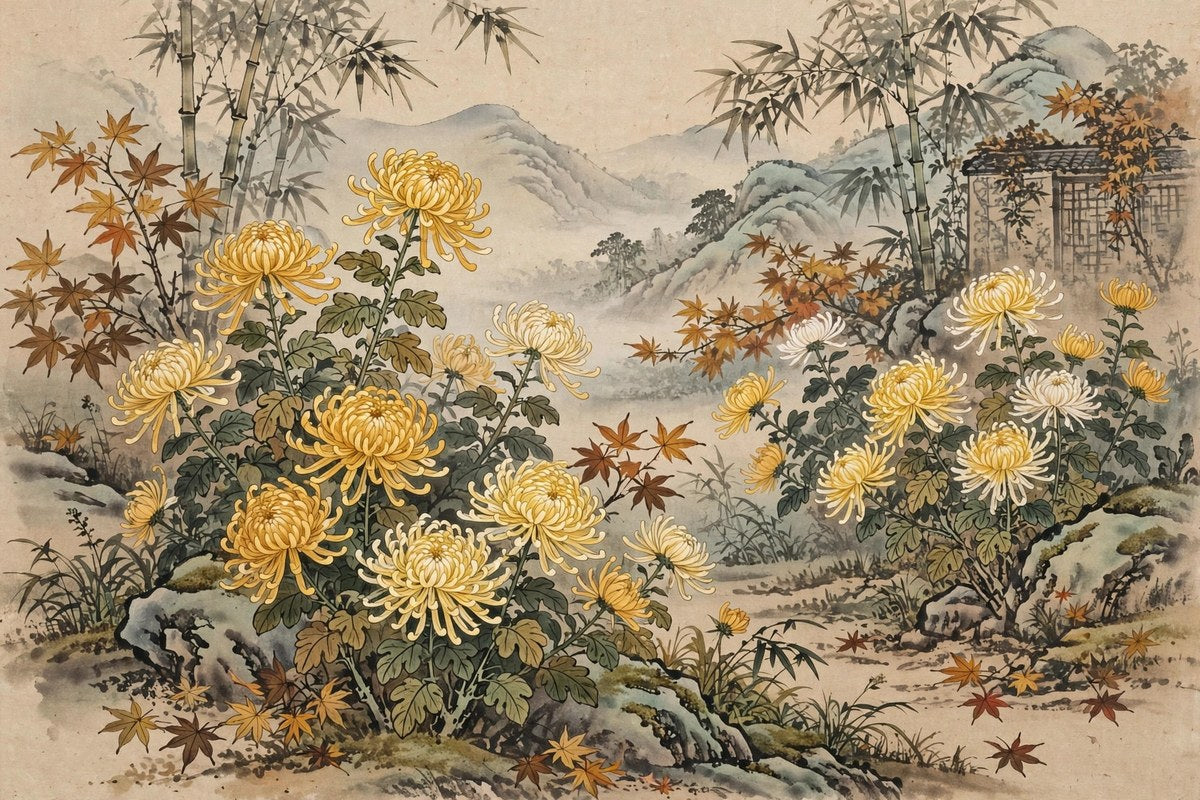
Chrysanthemums happen to be a perfect subject for one of Chinese painting's loveliest techniques: the boneless (mogu) method, where petals are built from pure washes of color with no ink outlines at all. Done well, the flower looks as if it condensed out of mist. The Qing dynasty master Yun Shouping brought the technique to its height in his flower albums, and his chrysanthemums — layered golds, rusts, and whites — remain the benchmark nearly four centuries later.
When you look at a chrysanthemum scroll, notice a few things. First, the petal structure: Chinese painters distinguish dozens of cultivated varieties — tightly curled "lion's head" blooms, loose wild types, cascading forms — and a good painting names its variety in the brushwork. Second, the leaves and stems: chrysanthemum foliage is rough and serrated, and painters use dry, scratchy strokes for it as a deliberate contrast to the soft petals. That contrast — delicate flower, rugged leaf — is the visual version of the flower's meaning: gentleness armored by toughness.
Third, look for companions. Chrysanthemums are often painted with rocks (endurance squared), butterflies (the sweetness of a well-lived autumn), or a wine cup (Tao Yuanming's ghost at the table). Each pairing adjusts the message the way an adjective adjusts a noun — and learning to read these combinations is half the pleasure of collecting flower-and-bird scrolls.

Hanging and Giving Chrysanthemum Art
Placement matters with symbolic art, because the meaning should match the room's job. Hang chrysanthemum paintings in the living room where guests gather — it tells visitors what this household values — or in the study, where its message of quiet fortitude does its best work. Bedrooms are fine too, though many collectors prefer calmer subjects there; the chrysanthemum's energy is reflective rather than restful, better suited to rooms where people think and talk.
As a gift, the rules are generous. Chrysanthemum art suits mentors, teachers, and elders above all — anyone whose years you want to honor rather than merely acknowledge. It works for retirements (the principled-retreat meaning lands beautifully), milestone birthdays, and recoveries from illness, where the longevity wish is literal. One caution from tradition: in some contexts white chrysanthemums are funeral flowers, so for celebratory gifts, favor paintings with golden, red, or multicolored blooms.
If you are choosing a piece, look for paintings where the flower gets room to breathe — generous empty space around the blooms is the hallmark of the scholar aesthetic. Our chrysanthemum scroll paintings are traditionally mounted with silk borders, and huaxin painting-core prints offer the same subjects unmounted, ready for your own framing.

Trends in art come and go, but the chrysanthemum has held its meaning for over sixteen hundred years — through dynasties, revolutions, and the entire modern art world. That staying power is, fittingly, the point: the flower does not chase spring. It waits, it endures, and it blooms exactly when blooming is hardest.
Whether you hang it for Tao Yuanming's integrity, for a parent's birthday, or simply because gold petals against silk are beautiful in the October light, a chrysanthemum painting brings a rare daily reminder into your home — that the long game is the one worth playing. Browse our flower-and-bird scroll collection and find the autumn flower that speaks for you.