
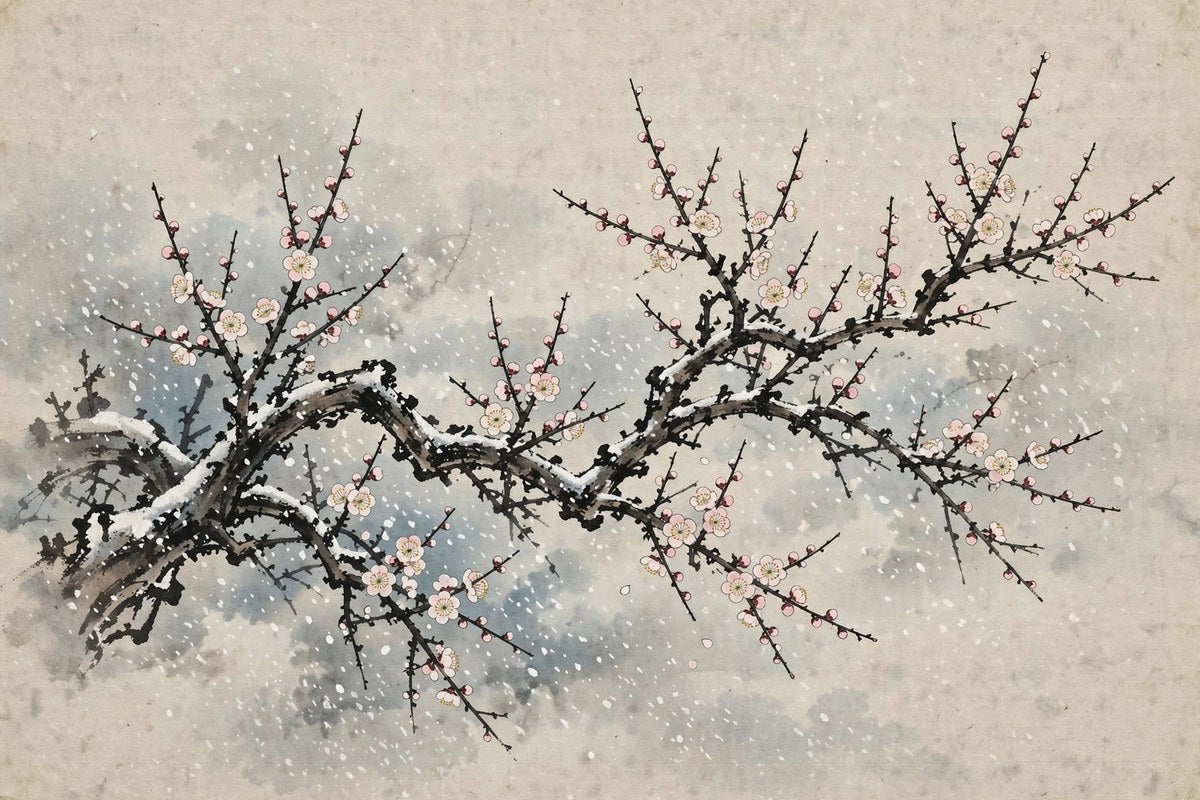
While the rest of the garden sleeps, one tree dares to bloom. The plum (meihua) opens its blossoms on bare black branches in the bitter cold — sometimes straight through snow. No wonder China made it the supreme emblem of perseverance, purity, and quiet courage.
If you're drawn to the plum blossom painting meaning, you're in eight centuries of good company. To paint this flower was a scholar's way of saying: I will hold my principles when everything around me freezes. Generations of painters tested themselves against its gnarled branches — and the best of them never really finished the test.
This isn't a flower you stumble across on a pleasant spring walk. The plum demands that you notice it at the worst time of year, when nothing else is even trying. That timing is the entire message — and it's why plum blossom art still hangs in studies, studios, and exam halls across China today. Understanding what it meant to the painters who loved it will change how you see every inked branch you meet afterward.
Shop our collection: Flowers Chinese Scroll Painting – Silk Wall Art – Peaco | Flower and Birds Chinese Scroll Painting – Silk Wall Ar
Why Winter's Flower Matters Most
Here's the thing about plum: it blooms before spring. Alone, unapplauded, in the year's harshest hour. For Confucian scholars, that was the perfect picture of moral courage — virtue that doesn't wait for favorable conditions. A peony waits for sunshine and applause; the plum performs for an audience of nobody, in weather that would kill most flowers. When a scholar painted plum, he was really painting himself: unbending, unbought, and unimpressed by circumstance.
Count the petals and you'll usually find five — the Five Blessings (wufu): longevity, wealth, health, love of virtue, and a peaceful end. So a single spray of plum is really a compressed prayer for a complete life. Small wonder it shows up in so much chinese flower painting for the study. Look closely at any good plum painting and you'll notice the five-petaled structure repeated like a signature — a quiet arithmetic of blessing hidden inside the beauty.
The plum also anchors the famous trio known as the Three Friends of Winter (suihan sanyou): pine, bamboo, and plum — the three plants that stay green, or blooming, when everything else gives up. Together they stand for endurance, flexibility, and renewal, and a painting of all three together is one of the most given and most hung images in all of Chinese art. If you want one subject that carries the whole scholar's creed, this is it.

Wang Mian, Lin Bu & the Ink Plum
The Yuan dynasty master Wang Mian couldn't afford color, so he painted plum blossoms in ink alone — and proved the flower needed no red to prove its nobility. His ink-plum became the genre's gold standard, the one every later painter measured himself against. Wang was a poor scholar who supported himself by selling his paintings, and his plum branches, flung across paper with astonishing confidence, were both his livelihood and his self-portrait: elegance without money, dignity without rank.
A century earlier, the Song dynasty poet-recluse Lin Bu had simply moved in among the plum trees on Solitary Hill near Hangzhou and refused to come out. The blossoms' "sparse shadows" and "subtle fragrance," he wrote, were company enough. He never married and never took office — he called the plum his wife and the crane his son. His verses made the plum the flower of beautiful solitude, and gave every lonely scholar a patron saint. When you see a plum painting with a poem inscribed on it, odds are good the words are Lin Bu's, still echoing nine hundred years later.
Between them, these two figures defined what the plum means in Chinese art. Wang gave it technique: the idea that a branch rendered in pure ink, with no color to hide behind, could carry the full weight of the flower's character. Lin gave it a soul: the romance of the recluse who chooses blossoms over society. Every plum painting you encounter is still, in some way, a conversation between those two men — craft and feeling, brush and heart.
Painting the Plum: Force and Tenderness
Painting plum demands the opposite of delicacy. Branches get flung on with twisting, boneless force; blossoms are dabbed in with the brush's tip, petal by petal. Power and tenderness in a single composition. Students learn branches first — blossoms take years. The old teachers say that if your branches are weak, your blossoms will look like stickers someone pasted on. The branch must feel like it grew through a winter wind, or nothing else on the paper will convince.
The classic setup is ink branches with red or white blossoms, sometimes a moon hanging over a night scene. Solitude, made visible. The contrast between heavy black ink and weightless petal is the whole drama of the genre — darkness that the flower refuses to acknowledge. Modern artists in the chinese scroll painting collection keep returning to this same composition, and no two of them handle it the same way. Some make the branch writhe like a dragon; some make it stand like a calligraphic exclamation mark.
White blossoms carry a different weight than red ones. Red plum is celebration and vitality — a branch of fire against the cold. White plum is mourning and purity — the flower at its most restrained and severe. Serious collectors learn to read this difference the way a wine drinker reads a label. And the unpainted space around the blossoms matters as much as the blossoms themselves: in ink painting, the emptiness is the cold air, the snow, the silence the flower is blooming into.

Feng Shui & Gifting
For feng shui art for career success, plum belongs in the study, the studio, or the north sector — anywhere perseverance is the actual job description. Hang it where hard things get done, and it does its quiet work of reminding you to bloom anyway. It also makes a thoughtful gift for students facing exams or anyone pushing through a hard season: new parents, people starting businesses, friends in recovery. The message needs no translation.
Pair the plum with a magpie for the famous "happiness on your brows" blessing — the bird's name puns with joy, and magpie-on-plum is one of the most auspicious pairings in the tradition. Or hang it with pine and bamboo as the complete Three Friends of Winter. One caution for gift-givers: choose red or pink blossoms for celebrations, and avoid white-blossom pieces for festive occasions, since white is the color of mourning in Chinese culture. And when you want the artwork unmounted so you can choose your own framing, browse the chinese painting huaxin collection — the painting core gives you the image alone, finished exactly the way you like.
Size matters too. A small plum spray suits a desk wall or a reading nook; a large vertical scroll with a moonlit branch wants a taller wall where the eye can travel. In feng shui terms, never hang plum in a way that faces it toward a bathroom or a cluttered corner — a symbol of nobility deserves a clean line of sight. Treat it with a little ceremony and it returns the favor.

Conclusion
Hang plum blossom where resolve is needed — the study, the studio, the room where hard things get done. Eight centuries of scholars can't be wrong about what this flower says, and they said it in ink that still hasn't faded. Find plum blossom paintings that carry a thousand years of backbone, and let winter's flower do its quiet work on your wall.