
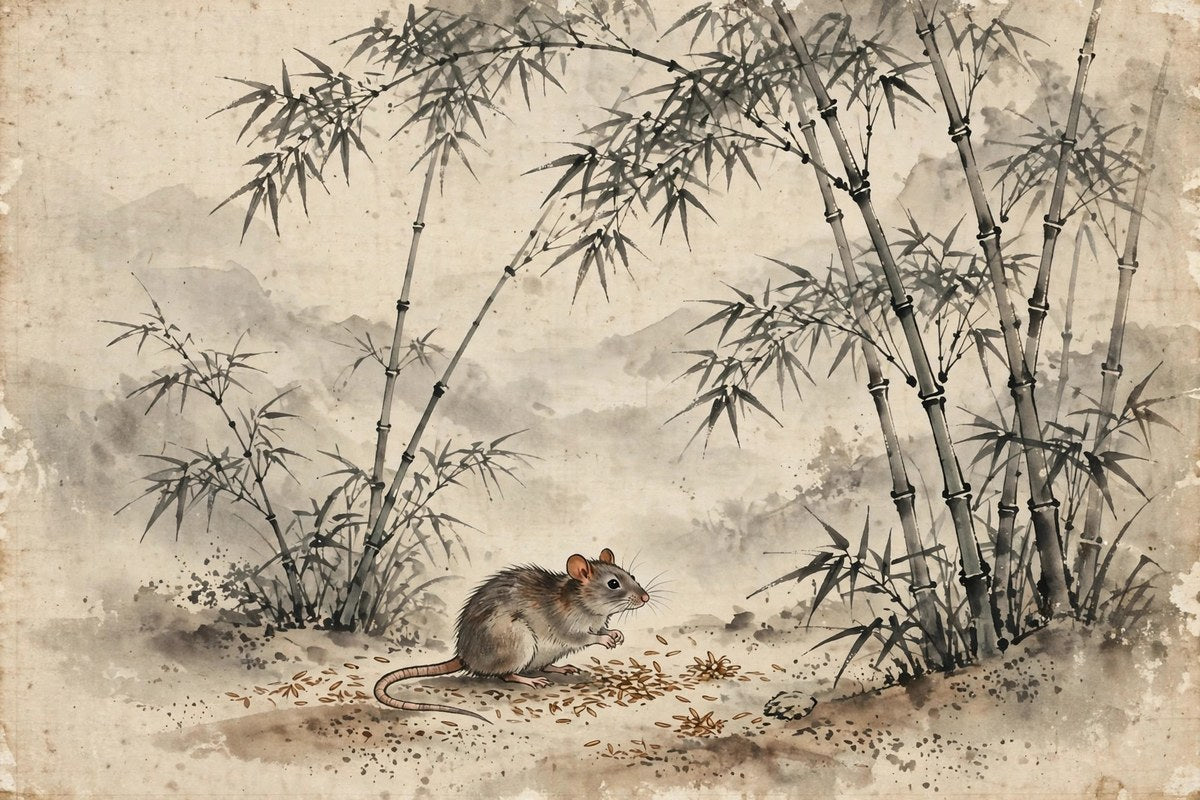
The Rat in Chinese Art: Small, Quick, and First in Line
Two of China's greatest painters once shared a single sheet of paper. Qi Baishi painted the mice. Xu Beihong added the cat. The result, Cat and Mice, still startles people: the mice are small, quick, and entirely unbothered, going about their business inches from a predator. That is the rat in Chinese art in one image — never the biggest animal in the room, usually the one still standing when the dust settles.
The rat (鼠, shǔ) leads the Chinese zodiac (生肖, shēngxiào), and it got there the same way it gets everywhere else: by thinking while stronger animals were still deciding. A rat painting is not a picture of a pest. It is a picture of resourcefulness, hung on the wall of a home or office that could use more of it.
The Race the Rat Won Without Running
Every Chinese child knows the story of the Great Race. The Jade Emperor announced that the first twelve animals to cross a wide river would each have a year named after them, in the order they arrived. The rat could not swim, so it asked the ox for a ride, climbed onto the ox's broad back, and rode across dry. Just as the ox lifted its front hooves onto the far bank, the rat leaped off the top of its head and landed on the shore first. The ox, which had done all the swimming, came second.
The story is folklore, not history. The animal system itself is far older: bamboo slips buried in a Qin dynasty tomb in 217 BCE already match animals to the earthly branches, though the set was not yet the same twelve we know today. But the story survives because it tells the truth about the animal. The rat wins by using what it has — a quick mind, a light body, and a willingness to accept help — instead of complaining about what it lacks. In Chinese art, the smallest creature in the frame is often the cleverest.
The rat is tied to the first of the twelve Earthly Branches, 子 (zǐ), and to the hours of 11 p.m. to 1 a.m., when rats are most active. It sits on the seam between yesterday and tomorrow: the animal of beginnings.
From Granary Pest to Sign of Plenty
Here is the contradiction at the heart of rat art. In a farmhouse, a rat in the grain store is a disaster. In folk art, a rat in the grain store is a blessing. Village artists painted what they saw: rats only gathered where there was grain to eat, so a house with rats in the granary was a house with food in it. Over time the pest became shorthand for abundance, and the rat began appearing in paper-cuts and New Year prints surrounded by grain and coins.
That is the first thing to understand before buying rat art. The rat does not symbolize wealth the way a gold ingot does. It symbolizes the ability to find and keep wealth: noticing the opening, getting through it, and storing something away for later — the difference between a windfall and a habit. A rat painting suits a home office or a new business far better than a formal living room: its message is practical, not decorative.
The rat also carries an older wish for fertility: rats breed fast, and folk art leaned into that without embarrassment. A pair of rats, or a rat among grapes and pomegranates, wished a couple a large family — abundance in every sense, not just money.
The Rat in Paintings, Paper-Cuts, and Coins
Serious painters took the rat seriously. Qi Baishi (1864–1957), famous for his shrimp, painted mice throughout his later years with a few quick, dry strokes — whiskers, a curved back, a tail that does the talking. Their collaboration is the best-known example: Qi Baishi's mice, small and alert, with Xu Beihong's cat added above them. It is a reminder that a humble subject in the hands of two masters is not a humble painting.
Folk artists took the rat in a warmer direction. Paper-cut rats, cut from a single sheet of red paper for Lunar New Year windows, are round and cheerful, often carrying a coin or an ear of grain — the rat as a neighbor, not a pest.
Collectors meet the rat a third way, on coins. China began issuing zodiac coins in 1981, and the newest cycle opened in 2020 with the Year of the Rat — the natural starting point for a twelve-animal set. A Chinese commemorative coin with a rat design is a compact way to mark a rat year — a birth, a graduation, a new business — without committing to a full scroll.
Your Rat Years — and the Two Elements That Shape Them
Each zodiac animal has a fixed element (五行, wǔxíng), and each birth year adds a rotating one — buyers mix them up constantly. The rat's fixed element is Water: flow, adaptability, and quiet persistence, going around obstacles instead of through them. The year element colors the picture:
- 1924, 1984 — Wood Rat: steady growth, strong instincts.
- 1936, 1996 — Fire Rat: energetic, bold, quick to act.
- 1948, 2008 — Earth Rat: practical, grounded, careful with money.
- 1960, 2020 — Metal Rat: disciplined, determined, strong-willed.
- 1972 — Water Rat: the fixed element doubled: intuitive, adaptable.
A person born in 1984 and a person born in 1996 are both rats, but not the same kind of rat. A note on the card — "for a Metal Rat" — shows you did more than pick an animal off a list.
The rest of the rat's profile is short and consistent. Lucky numbers are 2 and 3. Lucky colors are blue, gold, and green. Personality: quick-witted, resourceful, versatile, and kind — the kindness surprises people who only know the race story, but the rat in folk art is a family animal, quick to share what it finds.
Compatibility is where buyers most often go wrong. The rat gets along best with the Dragon, the Monkey, and the Ox — the Dragon and Monkey form the rat's trine (三合, sānhé), and the Ox is the rat's secret friend (六合, liùhé), the steady partner from the river crossing. The one pairing to avoid (相沖, xiāngchōng) is the Horse: the rat plans and stores, the Horse runs and spends.
One Date That Changes Everything
Before you buy a gift for a January or February birthday, check the Spring Festival date for that year. The zodiac year does not begin on January 1. It begins on Lunar New Year, which falls between January 21 and February 20, and anyone born before that year's Spring Festival belongs to the previous year's animal. The 2020 Spring Festival fell on January 25, so a baby born on January 10, 2020 is not a Rat at all — that child is a Pig. The same trap catches the famous example in the other direction: someone born in January 1990, before that year's Spring Festival, is a Snake, not a Horse. A wrong animal on a birthday gift is the most common mistake in zodiac shopping. When in doubt, check the date first.
Where to Hang a Rat
Put the rat where thinking happens. The study, the home office, and the entrance hall are the natural spots: the rat watches the door and the desk, the two places where opportunities arrive. Hang it at eye level, facing into the room.
Keep rat art out of the bedroom and the kitchen. The bedroom is for rest, and a quick, watchful animal on the wall works against that. The kitchen is worse: a rat near food, even a painted one, is a joke that stops being funny the first time a guest notices it.
Scale matters more with the rat than with most animals. A small scroll or a coin display suits the rat's character; a huge, dramatic rat dominates a room in a way the animal itself never would. Keep it modest, near the desk or the entrance, where it reads as a quiet wish for resourcefulness rather than a statement piece.
Choosing Your Rat
Start with the eyes and the whiskers. In a good rat painting the animal is alert, not frightened: ears up, whiskers forward, body ready to move. A cowering rat carries the wrong message. Folk-style rats should look round and cheerful; ink-style rats should look quick and precise. Pick the temperament that matches the room: folk warmth for a family space, ink precision for an office.
Composition is the second check. A single rat reads as a personal talisman, good for one person's desk or birthday. A pair of rats, or a rat among grain and coins, reads as a household wish — better for a wedding or a new home. Avoid a rat shown with a cat in a small domestic space; the Qi Baishi and Xu Beihong painting is a masterpiece, but its tension belongs in a study, not above a sofa.
If you are buying for a rat-year birthday, the rat zodiac collection gathers the animal's coins and gifts in one place, and a Chinese scroll painting in the rat's lucky colors — blue, gold, or green — makes the gift feel chosen rather than generic. Write the birth year on the card. The rat rewards people who check the details.