Of all the animals in Chinese painting, the horse is the one that seems to be moving even when it stands still. Ink horses rear, gallop, and toss their manes with an energy that jumps off the silk. For three thousand years the horse has been China's emblem of speed, strength, and success — the animal that carried armies, opened trade routes, and became a wish for anyone chasing a goal.
In Chinese the horse is ma, and it sits among the most respected creatures in the culture's symbolic menagerie. It is one of the twelve zodiac animals. It carried the imperial post. And in the famous blessing ma dao cheng gong — "may success arrive the moment the horse does" — it became the standard way to wish someone victory, whether in business, exams, or war.
This guide traces the horse from ancient battlefields to modern living rooms: why the great painter Xu Beihong made the ink horse his signature, why eight galloping horses are the ultimate success symbol, and where to hang a horse painting so its energy works for you, not against you.
Shop our collection: Eight Horses Chinese Scroll Painting – Silk Wall Art – | Eight Horses Chinese Scroll Painting – Silk Wall Art –
The Horse in Chinese History: War, Trade, and Prestige
To understand the horse in Chinese art, start with the horse in Chinese history — because for most of that history, horses were a matter of survival. The northern steppe nomads rode; the Chinese states that could not match them on horseback got overrun. By the Han dynasty (206 BCE – 220 CE), the empire was spending staggering sums to breed and buy war horses, sending expeditions deep into Central Asia for the legendary "heavenly horses" of Ferghana, steeds so fine that poets claimed they sweated blood.
The horse opened the Silk Road as surely as any merchant did, and it became the era's measure of wealth and reach. Tang dynasty tomb figurines — those glossy ceramic horses you see in museums — were buried with aristocrats precisely because a fine horse was the ultimate status symbol: speed, power, and range in one animal.
Painters noticed early. Han Gan, the great Tang dynasty horse painter, reportedly dreamed of horses and woke up sketching. His horses are muscular and spirited — and they set the template for a thousand years: the horse as noble energy, painted not as livestock but as a force of nature.
Xu Beihong and the Modern Ink Horse
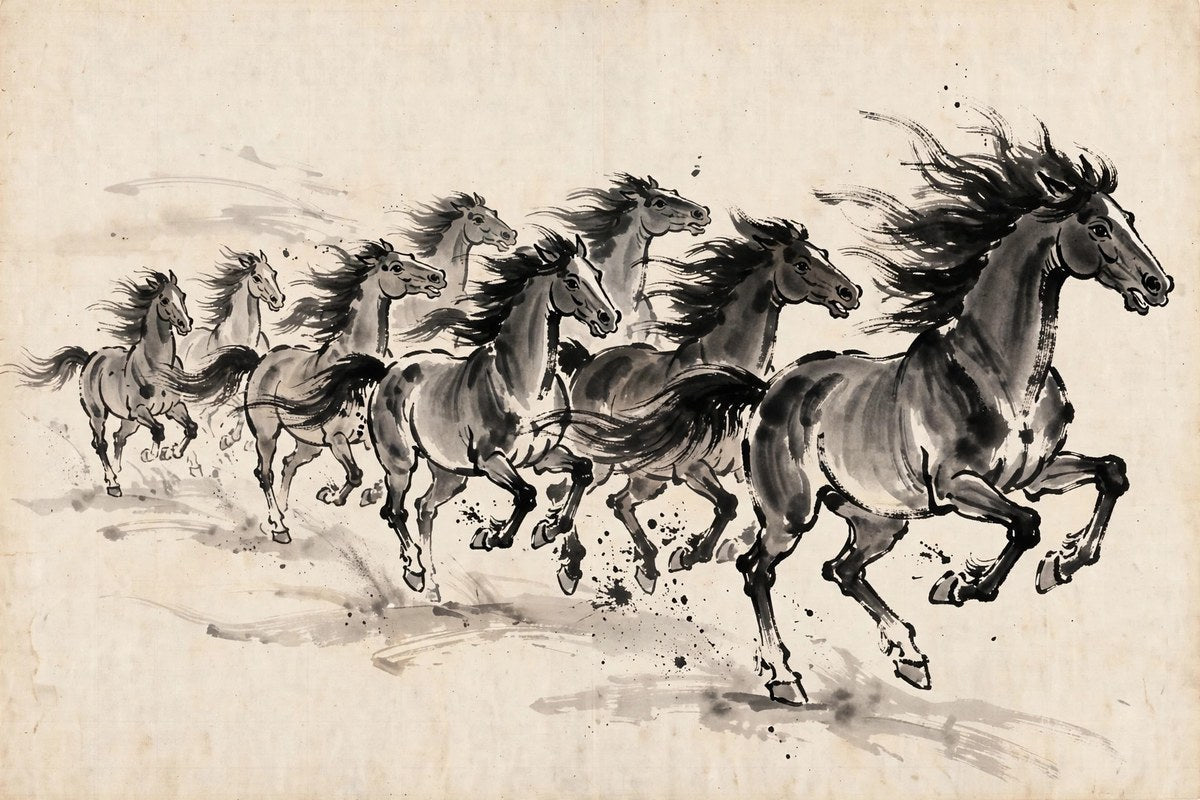
No name is more closely tied to the painted horse than Xu Beihong (1895–1953). Trained in classical Chinese brushwork and Western anatomy in Paris, Xu painted horses that were anatomically convincing and emotionally explosive at once. His galloping horses — splashed ink, manes flying, muscles coiled — felt utterly Chinese in spirit while looking like nothing the tradition had produced before.
Xu painted most of his famous horses during the 1930s and 40s, when China was at war, and everyone understood what they meant. A horse rearing against the storm was the nation itself: battered, unbroken, still charging forward. His ink horses became icons of resilience, reproduced endlessly and hung in homes, schools, and offices as reminders to keep going.
Today, a Xu Beihong style horse painting remains one of the most requested subjects in Chinese art. Collectors love the combination of technical mastery and raw feeling — the sense that the painter captured a split second of thunder. When you look at a good ink horse, notice the economy: a few dozen strokes for the whole animal, yet every muscle reads. That is the Xu Beihong legacy, and painters are still chasing it.

Eight Horses: Why Eight Galloping Horses Mean Success
If you have browsed Chinese art at all, you have seen it: eight horses thundering across a scroll, manes streaming, hooves kicking up dust. The composition has a name — ba jun tu, "picture of eight steeds" — and a history that reaches back to a real stable.
The story goes that King Mu of Zhou, who ruled around the 10th century BCE, owned eight legendary steeds, each with its own name and color, each faster than rumor. Court artists painted them, poets praised them, and the eight horses became shorthand for an unbeatable team — every talent present, every direction covered, nothing able to slow them down.
The number eight does heavy lifting here. In Mandarin, eight (ba) sounds like the word for prospering, so eight horses means prospering from every direction at once. A painting of eight horses is not just fast animals; it is success made systematic.
That is why the eight-horse painting is the classic gift for business openings, promotions, and new ventures. Paired with the blessing ma dao cheng gong — success arriving with the horse — it wishes the recipient not just effort but arrival. Note the direction convention: the horses should gallop into the picture, toward the viewer's space. When you buy, check which way the lead horse faces.
Feng Shui: Where Horse Paintings Belong
Horse paintings carry strong, active energy, and traditional placement guidance treats them with appropriate respect. The rules are simple once you know the logic: horses represent forward motion, so you want that motion aimed at something worth reaching.
Office or study, on the south wall. South is the direction of fame and recognition in feng shui, and the horse — the zodiac's most driven animal — belongs there. Behind the desk is the power position: the herd at your back, pushing you forward. Business owners have hung horse paintings here for generations, and it remains the single most traditional placement.
Living room, horses facing inward. The horses should run into the room or toward the interior of the home — never toward a door or window. Horses galloping out the front door are, symbolically, taking your success with them.
Near the entrance — with care. Some practitioners recommend a horse painting in the foyer, horses charging inward past the front door, as if success were arriving with every guest. It is a bold choice and it works in spacious entryways; in cramped halls the energy feels congested rather than inspiring.
Bedrooms: think twice. The horse's energy is the opposite of restful. If you want a horse in the bedroom, choose a calm composition — a single horse at rest, or horses grazing — rather than the full charge.
One more practical note, the same one that applies to every scroll: keep fine paintings out of kitchens and bathrooms. Silk, ink, and mineral color do not tolerate humidity, whatever the symbolism says.

Single Horse or Herd? Reading the Composition
Not every horse painting shouts. The subject has a whole vocabulary, and knowing a few of its phrases helps you choose well.
A single horse is the scholar's and the individual's choice. It suggests talent, independence, and the lone striver — the Dragon Gate spirit in equine form. A single horse rearing or turning its head to look back at the viewer is a particularly admired pose: spirit with awareness, power with intelligence.
A pair of horses suits couples and partnerships — two strengths running together. Three horses suggest steady progress. The full herd of eight is the business and ambition choice, the complete success formula.
Horses with riders shift the meaning toward journey and safe return. The classic composition "a horse bringing home" was historically given to travelers and soldiers — and today it suits anyone starting something far from home: a student leaving for university, a friend emigrating, a colleague posted abroad. The wish is built into the image: go far, come back well.
Style sets the mood. Fine-line gongbi horses are dignified and detailed, suited to traditional rooms. Splash-ink xieyi horses in the Xu Beihong manner are all motion and feeling, and they hold their own in modern interiors better than almost any other classical subject — energy first, tradition second.

Bringing the Horse Home
The horse has been wished upon for three thousand years — by kings counting their stables, by generals before battle, by students before exams, by founders before launch day. A horse painting still means what it always meant: run hard, arrive well.
Whether you choose the thunder of eight steeds for the office, a single ink horse for the study, or an unmounted huaxin print to frame yourself, you are hanging one of the oldest encouragements in Chinese culture. Browse our horse scroll painting collection — and when you find the herd that moves you, check which way it runs. You want it running toward you.