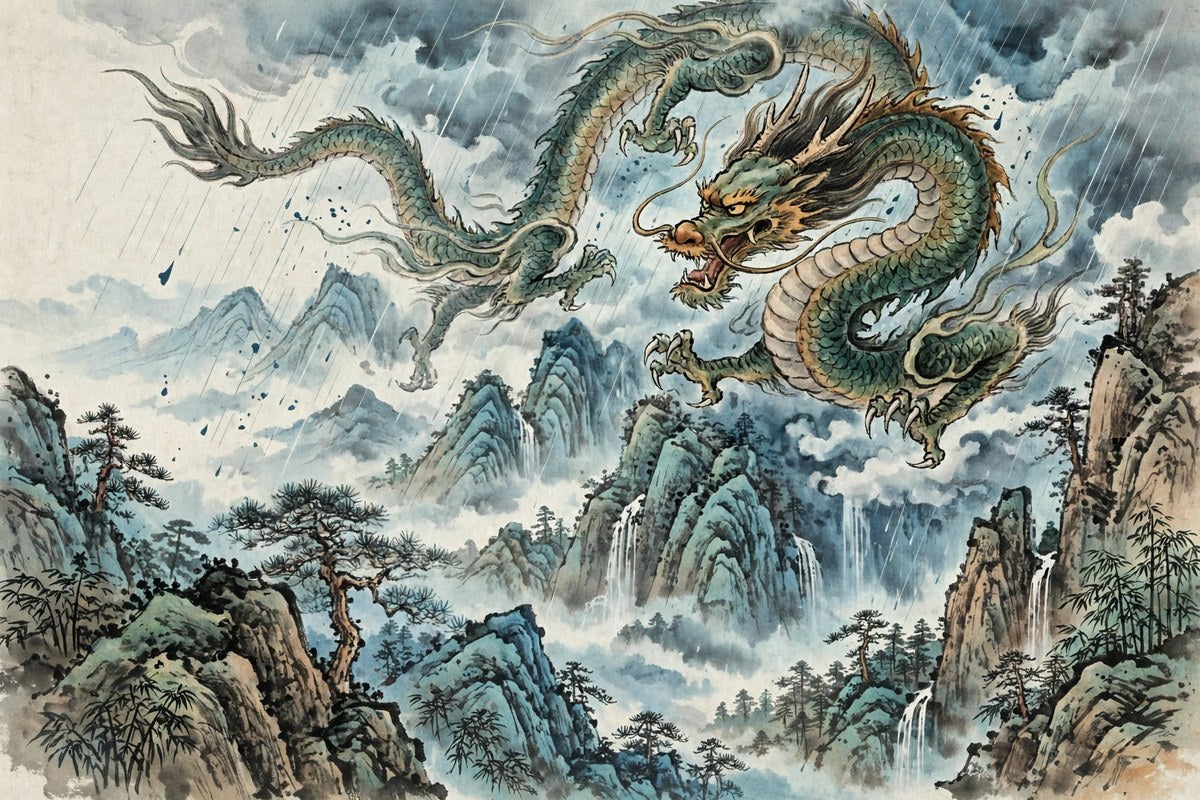
Forget everything the word dragon suggests in the West. The Chinese dragon, the long, does not hoard gold in a cave or breathe fire on villages. It rides the clouds, calls the rain, and brings the water that makes crops grow. It is the most powerful creature in Chinese art precisely because its power is generous: it gives life rather than taking it.
That is why the dragon sits at the top of the symbolic ladder. If you are drawn to the dragon meaning in chinese art, you are looking at a creature that stands for strength, authority, good fortune, and the rain every farmer prays for. Painters loved it, emperors claimed it, and ordinary families hung it in hopes that a little of its force would rub off on the household.
A Creature of Rain, Not Ruin
The Chinese dragon is stitched together from the best of many animals: the horns of a deer, the head of a camel, the eyes of a demon, the neck of a snake, the belly of a clam, the scales of a carp, the talons of an eagle, the paws of a tiger, the ears of a cow. Nobody ever claimed to have seen one whole, which is rather the point. The dragon is less a beast than a gathering of strengths.
Its home is water: rivers, lakes, seas, and the clouds above them. In a farming land, that made the dragon the creature you thanked when the rains came on time and begged when they did not. Dragon dances still wind through festival streets at New Year and at times of drought, not to frighten anyone but to summon rain and luck.
So when a dragon appears in a painting, read it first as a blessing, not a threat. It promises vigor, timely rain, and the kind of bold energy that gets things done. A dragon that chases a flaming pearl is chasing wisdom itself, a prize never quite caught and always worth the pursuit.
The Emperor's Emblem: Five Claws and Imperial Yellow
From early imperial times onward, the dragon belonged above all to the emperor. The throne was called the dragon throne, the emperor's robes were dragon robes, and his face, in courtly flattery, was the dragon countenance. To wear the dragon was to claim the Mandate of Heaven, the right to rule.
Court rules sharpened the symbol over time. The imperial dragon was given five claws on each foot, while lesser dragons in general use were shown with fewer, a visible ranking system written in talons. Imperial yellow, the color reserved for the throne, became the dragon's own color too. A yellow five-clawed dragon on a robe or a screen left no doubt about whose authority it announced.
That is why dragon imagery carries such weight in a room. It is not casual decoration. It is the visual language of authority and ambition, and it suits places where decisions get made and where a household wants to feel its own backbone.
How Painters Paint a Dragon: Mostly Hidden
Here is the painter's secret: a good dragon is mostly not there. Masters of the tradition show the creature winding through cloud and mist, a claw here, a horn there, a stretch of scaled back vanishing into vapor. The eye completes what the brush withholds, and the dragon feels enormous precisely because you cannot take it all in at once.
The technique is demanding. The body must twist and coil with the force of a creature that can stretch across a whole scroll, yet every scale and whisker needs control. Painters often worked in ink alone for dragons, letting graded washes do the work of cloud, water, and storm light. Color, when it appears, tends toward mineral greens and golds that keep the creature stately rather than gaudy.
Look at dragon scroll paintings with that rule in mind and you will start to see the game: how much dragon the painter dares to hide, and how much your imagination supplies. The best ones make you lean in closer, which is exactly what a creature of clouds should do.
Dragon Art at Home: Power in the Right Place
In feng shui terms, the dragon belongs to the east, the direction of sunrise and spring growth, and to water. A dragon above a desk or in a study suits ambition and career, a dragon in the living room suits a household that wants presence and confidence. Pair it with water imagery, a river or a lake scene, and the symbolism reads naturally, since that is where dragons live.
A few cautions keep the power friendly. Do not hang a dragon facing straight out the front door, as if the household's energy were leaving with it, and do not crowd it into a small, dark corner where it cannot breathe. Dragons like space and a sense of movement. Give the creature room to wind and the room feels larger for it.
As a gift, dragon art suits graduations, promotions, new businesses, and anyone starting something bold. It says, in the most traditional way possible, go far and go strong. For a formal version of the subject, browse landscape scroll paintings where dragons and storm clouds share the sky, or gift ideas for him for a strong, auspicious present.
Final Thoughts
The dragon endures because it promises the two things every household wants most: the strength to act and the rain to grow. Hang it where ambition lives, give it space and water, and let a thousand years of cloud and thunder work quietly on your wall. Find dragon paintings that bring power home without a hint of menace.