Stand in front of a Western landscape — a Constable, a Bierstadt — and the painting asks your eye to look: to admire the light, the distance, the craft. Stand in front of a Chinese mountain-water painting and something different happens. The painting asks your mind to wander. For a thousand years, scholars who couldn't travel — or wouldn't serve a court they despised — walked these painted mountains instead, in the practice called "spiritual wandering" (woyou): lying on a couch, unrolling a scroll, and traveling without moving.
That is the whole secret of how to read chinese landscape painting, and it changes everything about how you look. You are not a spectator before a window. You are a traveler at a trailhead. The paths, streams, and bridges in the painting are not scenery — they are itineraries, laid out by the painter for your journey. Learning to follow them is learning the art form's native language.
This is the short course: how distance works in shanshui (literally "mountain-water"), what the mountain and the water each mean, who painted the great ones across a thousand years, and how to hang one so your own room becomes a trailhead. No background required — just willingness to take the walk.
Shop our collection: Landscape Chinese Scroll Painting – Silk Wall Art – Guq | Landscape Chinese Scroll Painting – Silk Wall Art – Blu
The Three Distances: How to Walk In
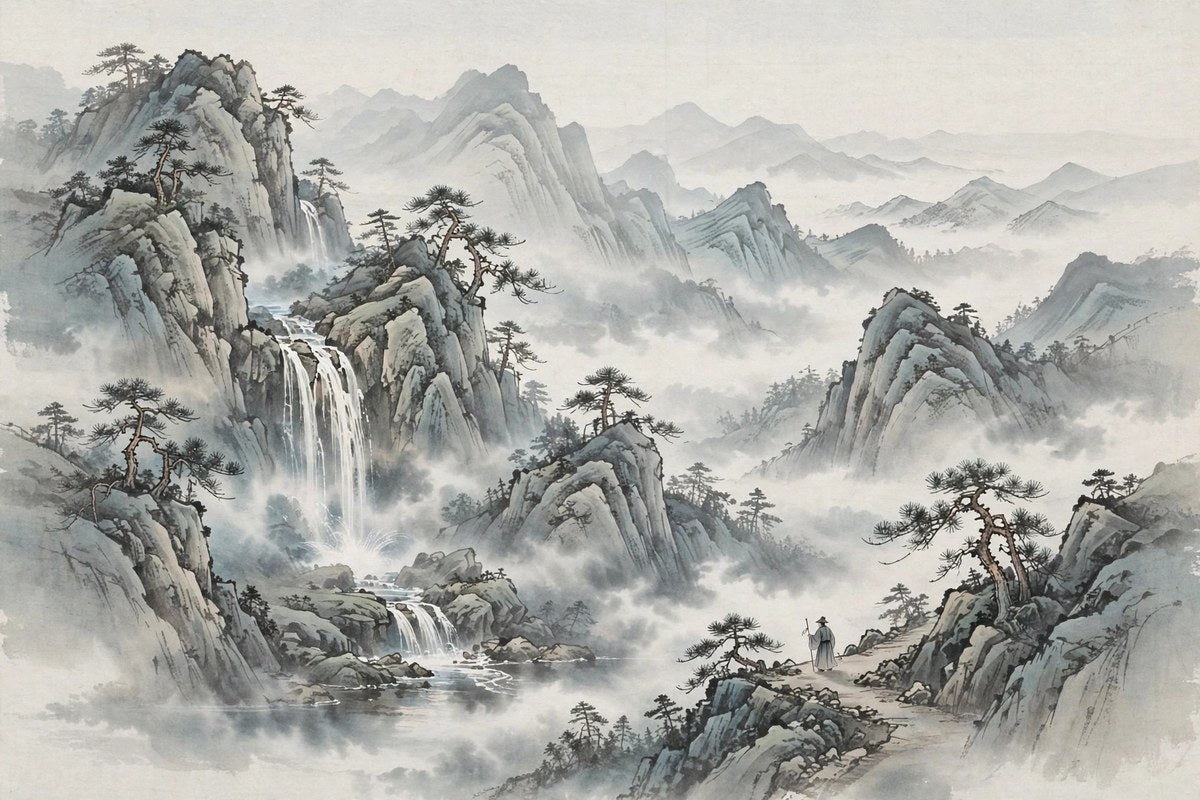
Around the year 1080, the Song-dynasty master Guo Xi wrote down something no Western theorist had attempted: a systematic account of how distance works in painting. He taught three distances (san yuan), three ways of seeing that a great painting combines. High distance (gao yuan) gazes up at towering peaks from below — the mountain looms, you crane your neck. Deep distance (shen yuan) stacks layered ranges receding into mist — the eye plunges backward through valley after valley. Level distance (ping yuan) stretches misty waters wide to a far shore — the gaze drifts sideways into calm.
Here is the radical part: a single painting can — and should — use all three at once, shifting your viewpoint as your eye moves across the silk. Western perspective fixes you to one spot, like a camera. Guo Xi's distances move you: the eye climbs a cliff face, drops into a gorge, then floats out over a lake, all within one composition. Once you notice this, you will never unsee it — the painting stops being a picture and becomes a route.
So the practical technique is simple: follow the paths and streams. Painters lay them deliberately — a trail winding from a foreground pavilion, a stream leading the eye around a cliff, a bridge marking the crossing into the far distance. Trace them slowly, the way you'd walk. Notice where the painter puts a rest stop: the pavilion, the fisherman's hut, the temple half-hidden in cloud. You are not viewing a scene; you are traveling through one. That is what woyou means, and it is available to anyone willing to look slowly. Browse classic landscape scroll paintings and try it — pick any mountain scene and walk it with your eyes before reading on.

Mountain, Water & the Tiny Traveler
Every shanshui painting is built from two characters, and they are a philosophy. Mountains are yang — stable, upright, enduring, the moral backbone of the world. Water is yin — flowing, yielding, adaptable, the wisdom that goes around obstacles instead of through them. Their balance within the composition is the painting's meaning: the Daoist harmony of opposites, rendered in ink and wash. That is the core of shanshui painting meaning, and it is why these paintings feel profound even before you know any of the history — you are looking at a worldview, not a view.
The proportions carry the philosophy too. Notice how small the human figures are — a fisherman poling his boat, a traveler with a staff on a mountain path, two friends in a pavilion the size of a thumbnail. They are never the subject. They are you: the wanderer, placed in the vastness for scale and for soul. The painting's true subject is the relationship between the tiny conscious being and the immense, indifferent, beautiful world — and the quiet suggestion that the right response to immensity is not conquest but contemplation.
Also notice what is missing: there is almost never a single dramatic focal event — no storm breaking, no battle, no sunset blazing for effect. The empty space — the unpainted silk standing in for mist, sky, water — is as composed as the brushwork. In Chinese aesthetics, emptiness is not absence; it is the most active element in the painting, the space where your own wandering happens.

A Thousand Years of Mountains
The tradition has a history as layered as its mountains, and knowing the eras deepens the walk. The Northern Song (960–1127) gave us monumental grandeur: Fan Kuan's "Travelers Among Mountains and Streams" towers like a cliff face, all massive central peak and tiny humanity — the cosmos as overwhelming order. Guo Xi himself painted the imperial court's vision of nature: vast, intricate, politically reassuring.
The Yuan dynasty (1271–1368) answered with something intimate. Its masters were scholar-officials who refused to serve the Mongol court, painting instead in exile and memory — drier brushwork, flatter compositions, landscapes as self-portraits of the mind rather than descriptions of place. Huang Gongwang's "Dwelling in the Fuchun Mountains" unrolls like a life: slow, cumulative, personal. Then the Ming and Qing Orthodox school codified the tradition into teachable styles, and modern masters like Huang Binhong drenched it in rain and ink — dark, wet, almost abstract mountains that feel startlingly contemporary.
One thousand years, one continuous walk. The styles change — monumental to intimate to codified to expressionist — but the invitation never does: come in, wander, stay a while. Our huaxin landscape prints follow the whole trail, from Song-style grandeur to misty modern moods, in the unmounted format that lets you frame the journey your way.

Hanging & Feng Shui
Hang landscapes where the mind needs space: living rooms, studies, meditation corners, the wall behind a desk that faces too much blankness. The format matters — a vertical scroll suits the towering-peak compositions (high distance wants height), while wide, misty scenes breathe better in horizontal formats or generous framing. Give the painting room around it; a landscape crowded by furniture is a trail with no trailhead.
In feng shui terms, a solid mountain composition hung behind the sofa or desk gives support — the "mountain at your back" every leader supposedly wants. Misty waters to the side suggest flowing opportunity. Water should flow inward or lie still, never pour out of the frame's edge. For a chinese mountain water wall art for living room pick, choose bright, welcoming scenes for active rooms — sunlit peaks, lively water — and misty, minimal ones for rest and contemplation. The mountain you hang is the mind you cultivate.
And consider the scholar's full setup: a landscape scroll on the wall, a porcelain brush rest or small vase on the desk below, tea at hand. Our Chinese porcelain collection includes the quiet vessels — cups, vases, brush washers — that complete a contemplative corner. The painting opens the distance; the objects anchor the near.

The Mountains Are Always Open
Learn to wander through a landscape painting and you will never need a ticket — the mountains are always open, the paths are always laid, and the tiny traveler waiting on the trail is you. Start with the three distances, follow the water, respect the mist, and let a thousand years of painters walk with you. Wander our landscape collection — pick a scroll, unroll it slowly, and take the walk.