Hidden in deep valleys, fragrant though no one passes by. That's how the old texts describe the orchid (lanhua) — and why Confucius held it up as the portrait of humble virtue: excellent whether recognized or not. Where other flowers perform for an audience, the orchid keeps faith with itself, blooming where nobody is watching and scenting the air for nobody's praise.
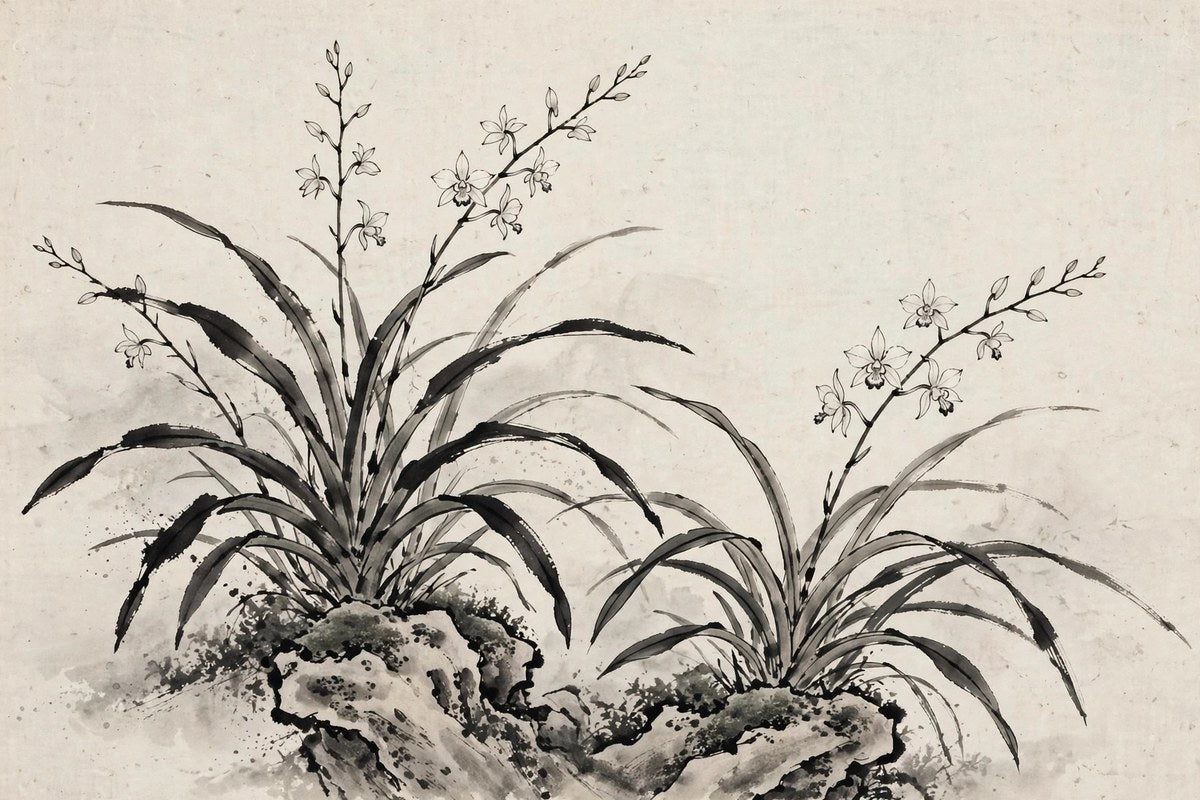
The orchid painting meaning in chinese art runs deeper than decoration. On paper, the orchid is pure discipline — long leaves drawn in single unbroken strokes, each one a test of the painter's breath, balance, and nerve. One wobble and the whole leaf is ruined; there is no erasing, no painting over, no second chance. That merciless honesty is exactly why scholars loved it. To paint an orchid well is to prove something about yourself.
Collectors sometimes overlook the orchid because it refuses to shout. Peonies blaze, plums defy winter, bamboo cracks like calligraphy — and the orchid simply sits there, quiet as a held breath. But hang one in a room and watch what happens to the noise. Few subjects in Chinese art quiet a space so completely, and understanding why will change the way you think about where to hang orchid painting in your own home.
Shop our collection: Bird on Tree Chinese Scroll Painting – Silk Wall Art – | Birds and Flowers Chinese Scroll Painting – Silk Wall A
Virtue That Needs No Audience
The orchid's valley seclusion made it the emblem of the gentleman in obscurity — talent and integrity that need no audience. Confucius compared the virtuous person to orchids growing in a deep forest: they don't stop being fragrant just because no one is there to smell them. Where the peony performs for the court and the plum makes its statement against the winter sky, the orchid asks for nothing. That humility is the whole point, and it made the orchid the private flower of the scholar class.
That humility is also what makes orchid painting such calming art for a meditation room. The leaves curve and cross in rhythms that slow the eye down; the sparse blossoms float like afterthoughts. Hanging an orchid scroll is the visual equivalent of lowering your voice. It's the scholar's flower, for the scholar's wall — or for anyone whose home needs one genuinely peaceful corner, a place where the mind can stop performing and simply rest.
There's a useful contrast here with the other great literati subjects. Bamboo is the orchid's usual companion, and the two together — sometimes called the "two purities" — represent the complete scholar: bamboo for uprightness and flexibility, orchid for hidden virtue. When you see them paired in a painting, you're looking at a Confucian character sketch in leaves and stalks. For collectors building a literati painting collection for beginners, an orchid-and-bamboo piece is the single most instructive purchase you can make.

Masters of the Single Stroke
The Qing dynasty eccentric Zheng Banqiao (Zheng Xie) made orchid-and-bamboo his lifelong signature, wielding a deliberately awkward, "ugly-beautiful" (chou) brush that broke every academy rule — and won immortality doing it. His orchids sprawl and lurch across the paper like handwriting in a hurry, yet every leaf lands exactly where it must. Zheng sold his paintings to support himself, pricing them by size on a famous price list, and turned commercial necessity into artistic legend. His orchids are proof that discipline and wildness are not opposites.
Centuries before him, Zhao Mengfu's orchid-and-rock compositions set the classical bar: restraint so complete it feels like held breath. Where Zheng's orchids shout, Zhao's whisper. His leaves are balanced to the millimeter, his blossoms placed like punctuation in a perfect sentence. Two masters, opposite temperaments, same flower — which tells you how much room this "simple" subject actually holds. Collectors argue endlessly about which manner they prefer, and the argument itself is the best evidence of the orchid's depth.
The orchid also attracted painters who wrote poems directly onto their leaves and blossoms, fusing text and image in a way no other flower quite invites. An orchid leaf is already shaped like a calligraphic stroke, so adding a line of verse feels natural rather than forced. When you encounter an orchid scroll with inscriptions climbing up the leaves, you're seeing the literati ideal at its purest: painting, poetry, and calligraphy — the Three Perfections (sanjue) — sharing a single sheet of paper. Browse the chinese scroll painting collection and compare how differently each master handles that same handful of leaves.
Technique: One Stroke, No Mercy
Orchid leaves use the nail-head, rat-tail, and mantis-belly strokes — each leaf a single gesture, thick at the base, tapering to nothing at the tip. A shaky hand has nowhere to hide. The orchid exposes every flaw and rewards every hour of practice, which is why teachers make students paint thousands of leaves before they're allowed near the flowers. Your wrist, your breathing, your state of mind on that particular morning — all of it shows up in the leaf. Painting orchids is, not incidentally, a form of meditation with a brush in your hand.
The flowers get dotted in afterward — small, precise, almost an afterthought. Here's the secret beginners miss: in orchid painting, the leaves are the subject. Get the leaves right and the flowers take care of themselves; get the leaves wrong and no amount of pretty blossoms will save the composition. This is the opposite of Western flower painting, where the bloom is the star and the foliage is background. In a Chinese orchid painting, the greenery is the philosophy and the flowers are just the punctuation.
That philosophy is what makes orchid scrolls so powerful in modern interiors. A minimalist room, a Scandinavian sideboard, a quiet hallway — the orchid's single-stroke leaves read as pure abstract gesture to eyes that know nothing about Confucius. You don't need to understand the symbolism to feel the calm. But once you do understand it, the calm deepens into something richer: you're hanging four hundred years of someone's practice, breath, and concentration on your wall.

Placement & Gifting
Hang orchids in the study, bedroom, or anywhere quiet is the point. Their restrained energy supports reading, reflection, and honest conversation — the opposite of loud, look-at-me decor. A small orchid scroll above a desk changes the feeling of work; a larger one in a bedroom softens the whole room. Avoid hanging orchids in busy, noisy spaces like entryways or kitchens, where their whisper gets drowned out. This is a flower that needs stillness around it to do its work.
As a gift, the orchid says I respect your character. That makes it one of the most thoughtful gifts for teachers, mentors, or anyone whose worth needs no advertisement — the retiring professor, the quiet colleague, the friend who does good work without posting about it. Unlike a peony (which can feel showy) or a dragon (which can feel aggressive), an orchid flatters without fawning. It tells the recipient: I noticed your quality, and I didn't need it announced.
For the collector who wants to choose their own presentation, an unmounted orchid painting core (huaxin) offers maximum flexibility — frame it in spare modern style for a contemporary interior, or have it traditionally mounted as a hanging scroll for the full literati effect. Either way, give the orchid what it asks for: a clean wall, good light, and a room that knows how to be quiet.

Conclusion
The orchid asks for nothing but attention. Give it a quiet wall, and it repays you with centuries of calm — the accumulated breath of every painter who ever steadied a hand to draw a single perfect leaf. Discover orchid paintings in our collection, and let the room breathe.