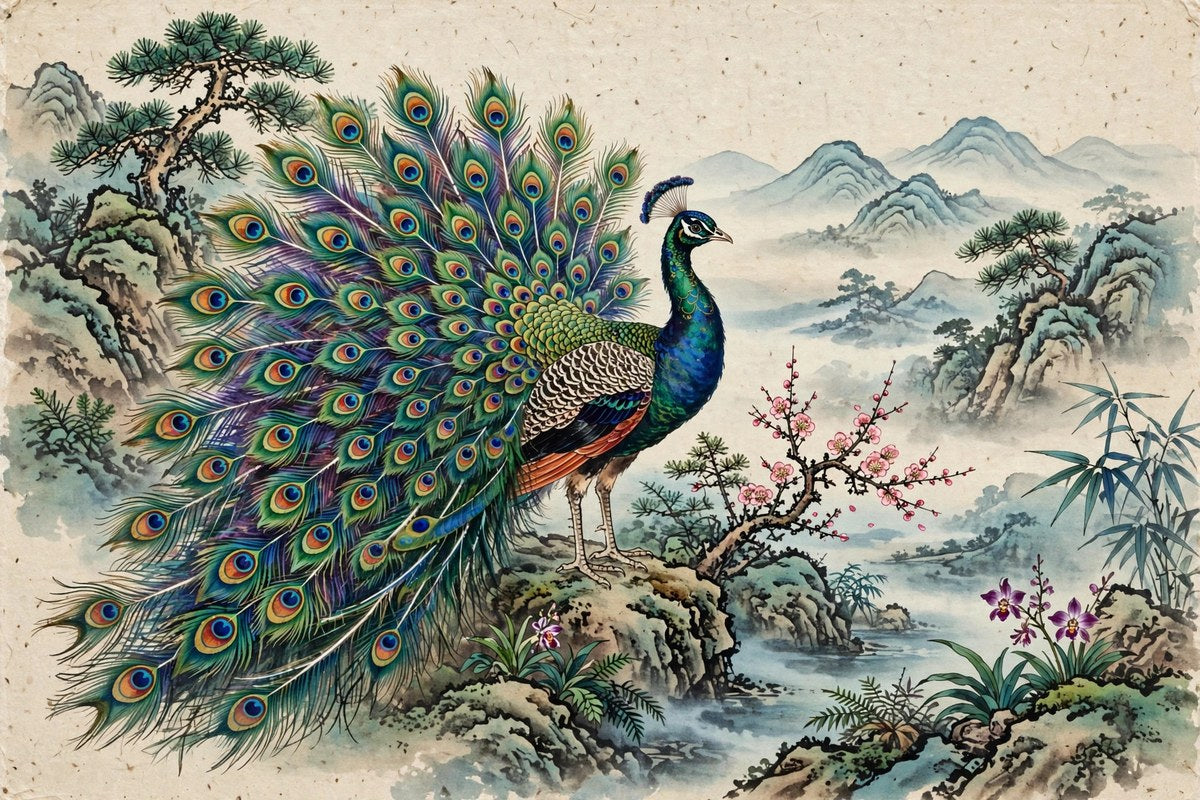
Few sights in Chinese painting are as immediately arresting as a peacock with its tail unfurled. The feathers fan out in a shimmering arc of emerald, cobalt, and gold, each eye-spot staring back at the viewer like something half bird, half guardian spirit. The Chinese have a name for this creature that captures its strangeness beautifully: kongque, the "empty sparrow" — empty because no ordinary bird contains this much splendor.
But a peacock painting on a Chinese wall was never just decoration. For two thousand years the bird has carried a loaded vocabulary of meanings: dignity in office, favor from the throne, moral vision, the ability to transform poison into wisdom. When Ming dynasty courtiers sewed peacock feathers into their official hats, they were wearing a résumé. When a painter laid a peacock across a silk scroll, he was making an argument about the household that would hang it.
This article follows the peacock through Chinese art — from Han dynasty omens to Buddhist temples to the Ming court — unpacks what the bird actually means in a painting, and finishes with practical guidance on where to hang peacock art and how to give it. If you have ever wondered about the peacock painting meaning in feng shui or why this bird appears on so many Chinese scrolls, here is the full story.

Shop our collection: Flowers Chinese Scroll Painting – Silk Wall Art – Peaco | Flowers Chinese Scroll Painting – Silk Wall Art – Peaco
From Han Omens to Imperial Gardens
The peacock entered Chinese consciousness as an exotic marvel. Han dynasty (206 BCE–220 CE) histories record peacocks among the tribute animals brought from the southern frontiers and beyond, and early texts treat the bird's appearance as an omen of good governance — a ruler whose virtue extended so far that even foreign marvels came to his court. To own a peacock was to make a claim about your reach; to paint one was to make a claim about your refinement.
By the Tang dynasty (618–907), peacocks were strolling the imperial gardens at Chang'an, gifts from kingdoms along the southern sea routes. Tang poets wrote of them as living jewels, and painters began rendering every feather-eye with mineral pigments — malachite greens and azurite blues ground fine enough to suggest iridescence. The technical challenge became part of the prestige: a badly painted peacock was worse than none at all.
Song dynasty painters gave the peacock naturalistic dignity — perched on rock or garden stone, tail sweeping behind, the posture of a creature that knows its own worth. Collectors of Chinese scroll paintings will find that Song naturalism still echoes in bird-and-flower works made today.
A Hundred Eyes: Dignity and Wisdom
The peacock's tail — "a hundred eyes" in the Chinese description — suggests all-seeing awareness. Court officials wore peacock feathers in their hats as marks of imperial favor, and the finest single-eyed feathers were reserved for the highest merit. In the Qing dynasty, the system grew precise: a feather with one "eye" marked ordinary merit, two eyes marked higher distinction, three eyes was almost never granted. To read a Qing official's portrait, you started at his hat.
This is why peacock imagery carries such weight in a painting. The hundred eyes read as moral vision — the capacity to see clearly, to judge fairly, to watch over what matters. A household that hangs a peacock scroll announces that it values dignity and discernment. In feng shui terms, the watchful eyes give the painting a protective charge: nothing sneaks past a hundred eyes. That protective quality is a large part of the peacock symbolism in Chinese art that buyers sense even before they can name it.
In Buddhist lore, the peacock's power to eat poisonous plants unharmed made it an emblem of turning poison into wisdom — a vivid image of spiritual alchemy that deepens any peacock painting meaning beyond decoration. The teaching is practical as well as poetic: difficulties, digested properly, become the very material of insight. A peacock in a study or meditation space carries that quiet instruction.
The Ming Court's Favorite Bird
The Ming court adored peacocks. They strutted through imperial gardens and across silk paintings in full gongbi splendor, every feather-eye laid down in malachite and lapis. The bird became shorthand for peaceful, prosperous reign — beauty as proof of good government. Imperial workshops produced peacock screens and hanging scrolls in which the bird shares space with peonies, the "king of flowers," doubling the auspicious charge: beauty joined to honor and wealth.
The Ming peacock painting also perfected the pairing with other auspicious subjects. Peacocks with peonies wished the viewer both beauty and high rank. A pair of peacocks, tail to tail, carried a wish for conjugal harmony and a flourishing family. These combinations are still the most popular in the Chinese painting huaxin print tradition.
Qing export painters later carried the peacock to Europe, where its exotic splendor shaped the Western imagination of Chinese decorative art. Eighteenth-century wallpapers, porcelain, and textiles borrowed the peacock freely, often without understanding a feather of its meaning. Today the circle closes: Western collectors hang peacock scrolls knowing exactly what the hundred eyes are saying.

Peacocks and Peonies: Reading the Classic Pairings
Learning to read a peacock painting repays the effort, because Chinese painters composed these scenes like sentences. The peacock itself says dignity, beauty, and watchful protection. Peonies add wealth, honor, and high social standing — the traditional wish fugui, riches and rank. Together, peacock and peony form one of the most direct good-wish compositions in Chinese art: may beauty and prominence arrive together and stay.
Other pairings shift the meaning. Peacock with chrysanthemum leans toward longevity and the integrity of the scholar in autumn. Peacock with plum blossom — winter's first flower — suggests dignity that endures hardship, a fine message for a home office or study. Peacock with bamboo joins moral uprightness to the bird's splendor. When choosing art for a specific room, these pairings let you fine-tune the wish the painting carries.
Single peacock versus pair matters too. A single bird, tail displayed, is a statement piece — confidence, prominence, the courage to be seen. A pair suggests harmony in relationships and is a thoughtful choice for a master bedroom or a wedding gift. Two peacocks with tails forming a near-circle create a composition of completeness that painters have used for centuries to wish a couple unbroken happiness.
Where to Hang & Who to Gift
Peacock art suits living rooms and reception spaces — anywhere you welcome guests and celebrate beauty. Its vivid color lifts a neutral room; its dignified bearing honors a formal one. As Chinese peacock art for feng shui display, it brings watchful, auspicious energy to social spaces. Hang it where the tail can open toward the room, ideally on a wall that faces the entrance so the hundred eyes greet whoever arrives.
Practical hanging notes: give a peacock scroll breathing room — a busy gallery wall dilutes the bird's authority. Good lighting matters more than for ink-wash landscapes, because the mineral colors reward it; a picture light or a spot aimed to avoid glare will make the feather-eyes glow. Keep it out of prolonged direct sunlight, which fades the malachite greens faster than ink tones. In feng shui placement, the living room's "wealth corner" or a prominent dining-room wall are the classic choices.
As a gift, the peacock wishes beauty, prominence, and protection — right for housewarmings, promotions, and anyone stepping into a brighter chapter. A peacock scroll says it without words, which makes it ideal when you want the gift to feel significant without a long explanation. For a promotion, choose the single displaying bird; for a wedding or anniversary, the pair; for a new home, peacock with peonies — prosperity for the new rooms.

Bringing the Peacock Home
Two thousand years of painters, monks, and emperors agreed on one thing: the peacock is never only a pretty bird. It is dignity you can hang on a wall, watchfulness that never sleeps, and the old Buddhist promise that even poison can become wisdom. Whether you favor the Ming court's jeweled gongbi style or a looser modern rendering, a peacock scroll brings confident, protective, unapologetically beautiful energy into a home.
Chinese Style Finds carries peacock compositions in both traditional scroll format and huaxin print form, from single displaying birds to the classic peacock-and-peony pairing. Browse the Chinese scroll painting collection to find the bird that suits your wall — and let a hundred eyes watch over your home.